
Unit V - Grammar
5.1.1 - PHONETICS
Write two words pronounced with
/p/
• pen
• paper
/f/
• fan
• fish
/θ/
• think
• thin
/s/
• sun
• sit
/ʃ/
• ship
• sheep
/aɪ/
• time
• fine
/z/
• zoo
• zero
/£/ ( = /l/ sound )
• lip
• love
/§/ ( = /ŋ/ sound )
• sing
• king
/ð/
• this
• that
/k/
• cat
• kite
5.1.2 - STRESS OF A WORD
Mark the stress of the words
-
Account → a’count
-
River → ’river
-
Education → edu’cation
-
Photography → pho’tography
-
Religion → re’ligion
-
Accuse → a’ccuse
-
Describe → de’scribe
-
Beautiful → ’beautiful
-
Examination → exa’mination
-
Object (noun) → ’object
-
Object (verb) → ob’ject
-
From → ’from
-
That → ’that
-
Arise → a’rise
-
Relate → re’late
-
Project (verb) → pro’ject
-
Project (noun) → ’project
5.1.3 - STRONG AND WEAK FORMS
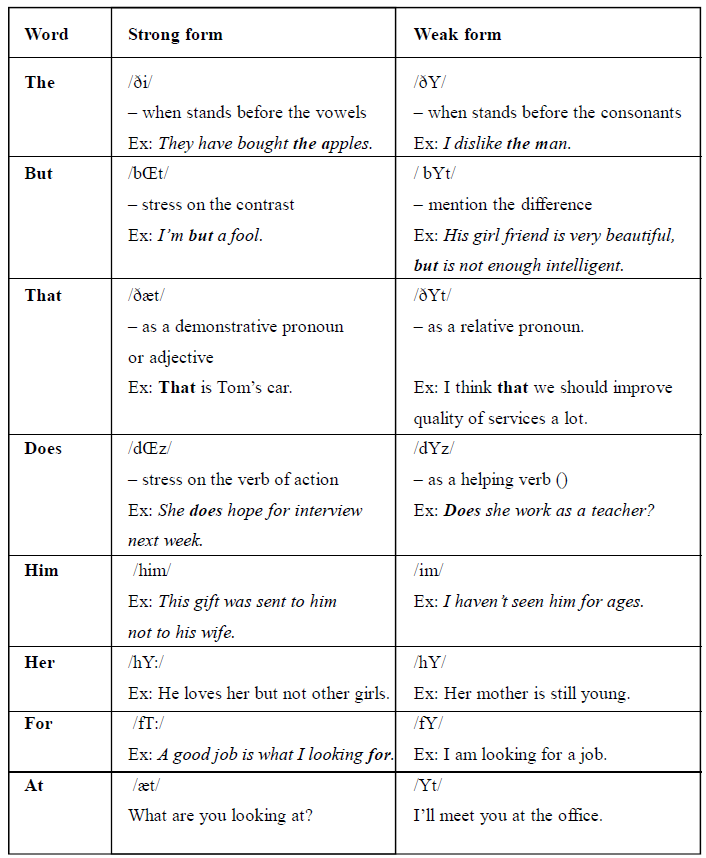
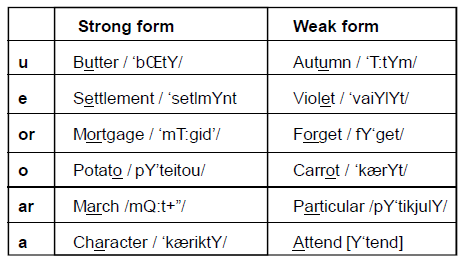
Mark the Strong and Weak forms
The
-
Strong form: /ðiː/
-
Weak form: /ðə/
From
-
Strong form: /frɒm/
-
Weak form: /frəm/
She
-
Strong form: /ʃiː/
-
Weak form: /ʃi/
Would
-
Strong form: /wʊd/
-
Weak form: /wəd/
5.1.4 - CONTRACTED FORMS
Write the following sentences with contracted forms:
-
I will come back tomorrow.
→ I’ll come back tomorrow. -
We have to go to temple now.
→ We’ve to go to the temple now. -
She would like to buy chocolates now.
→ She’d like to buy chocolates now. -
He will get the first prize.
→ He’ll get the first prize. -
They should reach the airport by 5 pm.
→ They should reach the airport by 5 pm. -
She has not achieved.
→ She hasn’t achieved. -
I will not see him.
→ I won’t see him. -
He would not appreciate this.
→ He wouldn’t appreciate this. -
Do not waste your time.
→ Don’t waste your time. -
You must not shout here.
→ You mustn’t shout here. -
He could have waited for us.
→ He could’ve waited for us. -
He cannot do it.
→ He can’t do it. -
She will not come here.
→ She won’t come here.
5.1.5 - SENTENCE STRESS
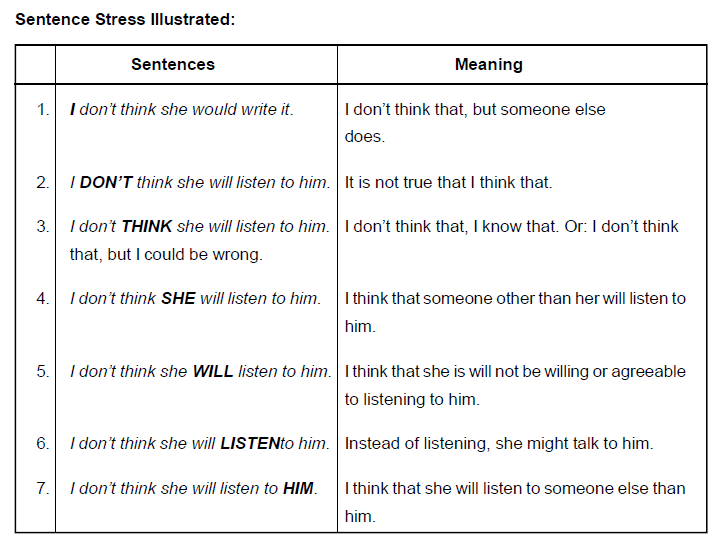
Mark the stressed word in the following sentences.
-
Can I see you TODAY?
-
It’s IMPOSSIBLE to please everybody.
-
The light’s wrong for PHOTOGRAPHY.
-
My mind went BLANK and everything blacked out.
-
Please bring me a CHAIR.
-
She’s going to the UK.
-
I ACHIEVED it.
-
I’m going to AMERICA.
-
She bought a HOUSE.
-
They tried AGAIN.
-
We OUGHT to leave.
5.1.6 - INTRODUCTORY - IT / THERE
INTRODUCTORY IT
Rewrite the following sentences using Introductory it.
-
To become a millionaire was his life-long ambition.
→ It was his life-long ambition to become a millionaire. -
To withdraw now will be sheer folly.
→ It will be sheer folly to withdraw now. -
To err is human, to forgive, divine.
→ It is human to err and divine to forgive. -
To learn English is easy.
→ It is easy to learn English. -
To understand his motive was difficult.
→ It was difficult to understand his motive.
INTRODUCTORY THERE
Rewrite the following sentences using Introductory there.
-
Some water is there in the bottle.
→ There is some water in the bottle. -
Quite a few animal species are in danger of extinction.
→ There are quite a few animal species in danger of extinction. -
No teacher was in the classroom.
→ There was no teacher in the classroom. -
A tree is in his yard.
→ There is a tree in his yard. -
No library is in their school.
→ There is no library in their school.
PYQ
Rewrite the following sentences using an introductory ‘It’ or ‘There’.
-
An elephant is under the shade.
→ There is an elephant under the shade. -
My ambition is to become a pilot.
→ It is my ambition to become a pilot. -
To err is human.
→ It is human to err. -
No place like home.
→ There is no place like home. -
To understand his motive was difficult.
→ It was difficult to understand his motive. -
Three parcels are there in the bag.
→ There are three parcels in the bag. -
His aim is to become doctor.
→ It is his aim to become a doctor.
5.1.7 ARTICLES
Fill in the blanks with suitable articles.
Gold is a precious metal.
Brutus is an honourable man.
The reindeer is a native of Norway.
Honest men always speak the truth.
John is a young boy.
5.1.8 PREPOSITIONS
Use the appropriate preposition given in the brackets.
This material is different from that.
You should explain this to them.
He has been absent since Monday.
I haven’t been to the theatre for a long time.
He goes to school by car.
5.1.9 FRAMING QUESTIONS
Frame suitable questions.
Ravi will prepare the draft today itself.
→ When will Ravi prepare the draft?
The men pulled the animal out using ropes.
→ How did the men pull the animal out?
You will find the keys on the table.
→ Where will you find the keys?
The man at the gas station will help you.
→ Who will help you?
They will close the shop at 9 pm.
→ When will they close the shop?
YES / NO QUESTIONS
They are visiting Paris.
→ Are they visiting Paris?
She has done the housework.
→ Has she done the housework?
Nancy has been working all night long.
→ Has Nancy been working all night long?
He will be reading the book.
→ Will he be reading the book?
He discovered the truth.
→ Did he discover the truth?
5.1.10 ADJECTIVAL / VERB FORMS
Fill in the blanks using suitable forms of the words given.
Once upon a time there lived a man called Damocles. A friend of his eventually became the ruler of a small city. Damocles thought, “How lucky my friend is. He is now a ruler. He must be having a great time. He must have fine clothes, lots of money and many servants. I wish I had his luck.” He decided to visit his friend. When he reached the palace, the king himself received him warmly. Damocles told the king that he was a lucky man. The king smiled and invited him to dinner.
5.1.11 VERBS
Fill in the blanks with suitable verb forms.
Someone is knocking at the door.
Good boys obey their elders.
Water boils at 100°C.
Birds fly in the air.
I received your letter yesterday.
My father will leave for Mumbai tomorrow.
The child is crying because it cannot find its mother.
My mother teaches in a college. She goes there in the morning.
He will go to Shimla tomorrow.
Thomas Edison invented the electric lamp in 1879.
5.1.12 TRANSFORMATION INTO NEGATIVE
Change the sentences into negative.
I do not like to read science fiction.
Dogs do not chase cats.
Dogs do not like to chase cats.
Pete does not want to talk with Ann.
Alice does not work for an insurance company.
I do not like this wine very much.
I do not enjoy playing with my kids.
Sharon does not make models from clay.
I do not practice the violin every morning.
My brother does not earn two hundred dollars a week.
5.1.13 CONNECTIVES
Fill in the blanks with suitable connectives.
Something must have fallen because I heard a sound.
You will win the first prize if you work hard.
He took out his brush and began to paint.
Hurry up or you will be late.
She may be poor but she will not take anything that does not belong to her.
5.1.12 REPORTED SPEECH
Rewrite in reported speech.
She said that she was reading.
They said that they were busy.
He said that he knew a better restaurant.
She said that she had woken up early.
He said that he would ring her.
They said that they had just arrived.
He said that he would clean the car.
She said that she had not said that.
She said that she did not know where her shoes were.
He said that he would not tell anyone.
ANTONYMS
Give the antonyms of the following without using prefixes
Bitter × Sweet
Meek × Bold
Tragic × Comic
Alien × Native
Hopeful × Despairing
Winner × Loser
Arrival × Departure
Instant × Delayed
Minimum × Maximum
Vanish × Appear